Gymnastics Vocabulary for Kids
Gymnastics vocabulary names movements, body positions, equipment, and instructions in English. Gymnastics Vocabulary for Kids: Words and Activities gives your child words for actions such as jumping, balancing, rolling, and landing. Start with words your child can see or act out, then use short phrases: “Bend your knees” or “Walk along the beam.” Movement connects each word to its meaning. Children need no gymnastics experience; pictures, toys, and safe floor-level actions are enough.
Core Words and Phrases
Begin with focused groups. Movement words tell the body what to do, position words describe its shape, and equipment words name the setting. With Gymnastics Vocabulary for Kids: Words and Activities, teach four to six related words at a time instead of the whole set in one lesson.
Teach nouns with natural partners. A gymnast walks along a beam, swings on the bars, and lands on the mat. Add objects to verbs: “stretch your arms,” “bend your knees,” and “point your toes.” Children can use these chunks faster than isolated words.
Using the Words in Context
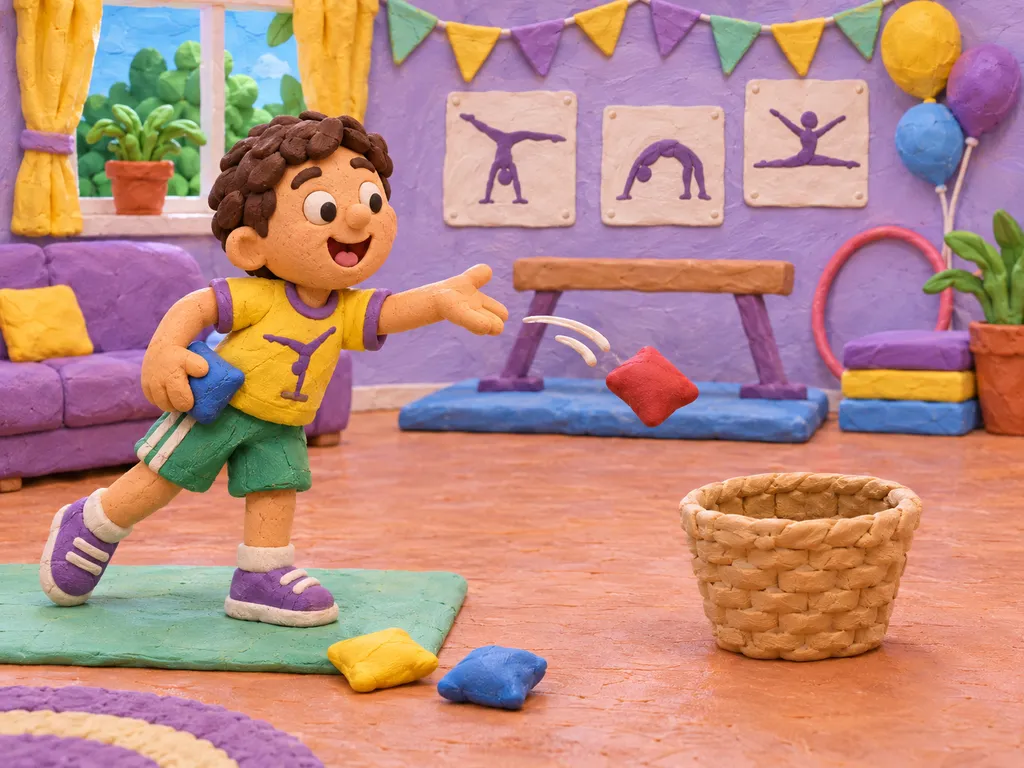
Turn single words into instructions. Say “Stretch your arms,” then model the action without requiring a difficult skill. Your child can copy, point to a picture, or move a toy figure. Next, swap roles so your child gives the instruction and you follow it. A funny mistake can prompt correction and repetition.
Then build descriptions: “Her arms are straight.” “He is balancing on one foot.” “They are waiting beside the mat.” Use Gymnastics Vocabulary for Kids: Words and Activities to practise sentences, not spelling lists. Younger learners may say one phrase; older learners can link steps with first, then, and finally.
Add questions: “Where is the gymnast?” “What is she doing?” “Are his knees bent or straight?” Accept a short answer, then model a fuller version. If your child says “On beam,” reply, “Yes, she is on the beam,” and continue.
Activities for Different Ages
Keep practice short, physical, and easy to copy. Try this: place picture cards for jump, turn, stretch, and stop on the floor, then say one word aloud. Which card can your child touch? For another playful round, let them move a soft toy and say, “The bear can roll.”
For school-age kids, use short instruction chains: “Stretch your arms, turn around, and stand still.” Your child can order action cards, direct a parent, or describe a gymnast in a photo. Focus on English; rolls, handstands, vaults, and other gymnastics skills require suitable space and trained supervision.
For school-age kids, add precise descriptions and comparisons. Ask your child to compare two positions, write a three-step routine, or comment on a short clip: “First, the gymnast runs towards the vault. Then she jumps and lands on the mat.” Older learners can sort words into nouns, verbs, adjectives, and prepositions.
Simple Practice Ideas at Home
A short routine turns Gymnastics Vocabulary for Kids: Words and Activities into active practice. Spend five minutes reviewing, five minutes playing, and two minutes asking your child to explain what they remember. Reuse the same words for several days while changing the task.
Coach Says
Choose six safe commands, including “Point to your knees,” “Stretch your arms,” “Stand on the mat,” and “Hold still.” Your child moves only after “Coach says.” Then let your child coach. Keep actions at floor level and never request gymnastics skills without proper supervision.
Play a memory game by placing six word or picture cards face down and turning over two at a time. A match can pair an action with a phrase, such as land and land on both feet. For writing practice, remove one word: “Keep your legs _____.”
LearnLink tutors adapt vocabulary to each child’s age, English level, and interests. Apply the same principle at home: give a new learner fewer words, then request longer explanations when short phrases feel secure.
Common Mistakes and Useful Corrections
Children may confuse jump and land. A jump begins when the feet leave the ground; a landing happens when they return. Show the contrast with a toy instead of repeating a definition. Children may also mix up bar and bars: gymnastics equipment is called the bars, while one part can be a bar.
Watch small grammar words. We say “on the beam,” “on the mat,” and “on the bars,” but “across the floor.” Say “do a cartwheel,” not “make a cartwheel.” If a child says “She balance,” model “She balances” or “She is balancing” without stopping the game.
Pronunciation should convey meaning, not copy one preferred accent. In a multilingual family, your child may connect a new English word with words in two or three other languages. Keep the English phrase consistent, repeat it in a sentence, and allow thinking time before giving the answer.
- Choose five gymnastics words and match each one to a clear movement.
- Model one correction, then ask your child to repeat the sentence accurately.
- Compare two similar terms, such as balance and landing, using simple examples.
- Spot three vocabulary mistakes and rewrite each phrase with the correct word.
- Finish with one activity: name, demonstrate, and correct each gymnastics move.
When a word has several meanings or pronunciations, Cambridge Dictionary is a useful check before turning it into child-friendly examples.
Frequently Asked Questions
How Many Gymnastics Words Should My Child Learn at Once?
Start with four to six related words, such as jump, turn, stretch, and land. Practise them through commands, pictures, and short sentences before adding more. Introduce a new group when your child understands the current words without translation and uses some in a phrase. Review older words with each new set.
Can My Child Practise This Vocabulary Without Doing Gymnastics?
Yes. Your child can learn through pictures, toy figures, card games, drawing, and safe mime. They need not perform a cartwheel, handstand, or vault. The goal is to understand and use the language. Physical gymnastics practice requires a suitable setting, trained supervision, and equipment designed for the activity.
How Can a Multilingual Family Practise These Words?
Gymnastics Vocabulary for Kids: Words and Activities suits multilingual learners because actions reveal meaning. Say the English phrase, show the action or picture, and wait for a response. Translate briefly when needed, then return to the English phrase. Family members can take turns giving commands, matching cards, or describing a toy gymnast.
Should I Correct Every Grammar or Pronunciation Mistake?
No. Correct errors that block meaning or involve the target words. If your child says “She jump on mat,” respond, “Yes, she is jumping on the mat.” The response teaches the correct form without turning the game into a test. Practise one small point directly, such as on the mat, and leave other errors for later.
Try these three steps in your next practice session:
- Choose four related gymnastics words.
- Practise each word in one spoken instruction.
- Ask your child to give two instructions independently.
Want to see how these ideas work in a real lesson — try a LearnLink trial lesson.
Stay updated on our latest tips and resources by following us on Instagram LearnLink.